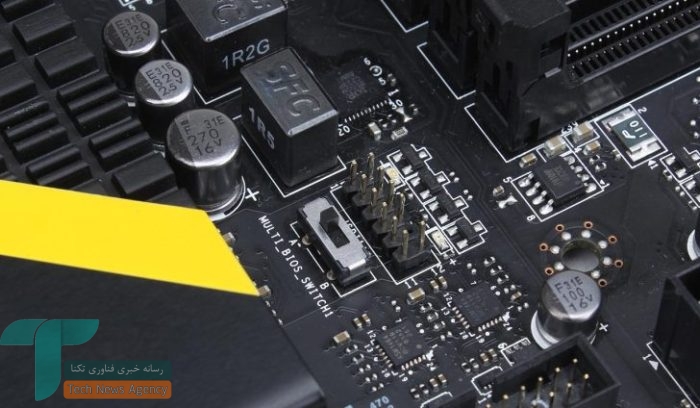
The People’s Republic of China has taken a decisive strategic step to lessen its reliance on proprietary technologies from firms like Microsoft and Intel by introducing the UBIOS domestic standard as an alternative to UEFI. Developed through a collaborative effort among a consortium of 13 leading enterprises and domestic research institutes, this new standard is built on a distributed architecture and offers full support for heterogeneous computing.
Unlike UEFI, which encounters significant constraints on platforms based on ARM and RISC-V architectures, UBIOS eliminates these barriers and provides a unified foundation for building an independent, scalable, and domestically controlled hardware ecosystem. This initiative underscores China’s serious commitment to achieving technological sovereignty at the foundational layers of hardware and boot firmware.
🔗 بیشتر بخوانید: مایکروسافت با ادغام ویرایشگر عکس در اج گامی بلند در جهت ترقی توانایی کاربری برداشت_سمسون
UBIOS Distributed Architecture: Advancing Beyond Centralized UEFI Model
The core distinction between UBIOS and UEFI lies in their design philosophy. While UEFI relies on a centralized, monolithic model heavily tied to the x86 architecture, UBIOS embraces a distributed and modular architecture. This design enables each hardware module — from the central processor to graphics accelerators, NPUs, and storage controllers — to maintain its own independent boot firmware and communicate via standard buses.
This approach delivers critical advantages:
🔗 بیشتر بخوانید: خرید روغن صنعتی به همراه مشاوره تخصصی از آژمان_سمسون
- Horizontal scalability: Adding new cores or specialized accelerators does not require rewriting the entire boot firmware.
- Fault resilience: Failure of a single module does not crash the whole system; other units can continue operating independently.
- Native optimization for heterogeneous computing: UBIOS inherently supports task scheduling across mixed architectures (CPU+GPU+NPU+DSP), an area where UEFI struggles.
Native ARM and RISC-V Support: Breaking Architecture Lock-in
One of UEFI’s persistent challenges has been its incompatibility with ARM64 and RISC-V architectures. Although ARM UEFI variants exist, their implementation is complex, costly, and often dependent on proprietary binaries. UBIOS was designed from the ground up for these two architectures and offers:
- Unified boot standards for ARM Neoverse servers, mobile SoCs, and embedded systems.
- Full support for RISC-V Supervisor Binary Interface (SBI) and RISC-V Platform Specification.
- Elimination of translation and shim layers present in UEFI for ARM, reducing boot latency by up to 40% in initial tests.
This capability empowers Chinese companies such as Alibaba (T-Head), Huawei (Kunpeng), Phytium, and RISC-V startups like StarFive and SiFive China to bring their hardware platforms to market rapidly without dependence on Intel/Microsoft licenses.
13-Member Consortium: Collective Power Serving Technological Sovereignty
UBIOS development is not a single-company project. The founding consortium includes:
- Government research organs: China Electronics Technology Group (CETC), Chinese Academy of Sciences (CAS).
- Technology giants: Huawei, Alibaba, Tencent, Baidu, Lenovo.
- Chip makers: Phytium, Kunpeng, T-Head, Zhaoxin.
- Server and datacenter vendors: Inspur, H3C, Tsinghua Tongfang.
This cross-sector collaboration ensures UBIOS is not merely a paper standard but a complete ecosystem with drivers, debug tools, simulators, and open documentation. The consortium has committed to publishing UBIOS specifications under the Chinese Open License, which is compatible with GPLv3 and Apache 2.0.
Security and Trust: A Domestic Root of Trust Model
Boot security is one of the most sensitive hardware layers. UBIOS introduces a domestic Root of Trust (RoT) model based on China’s national cryptographic algorithms (SM2, SM3, SM4) alongside international standards (RSA, ECC, SHA-2/3). Key security features include:
- Native Measured Boot: Hashing of all boot modules stored in a domestic TPM (TCM — Trusted Cryptography Module).
- Multi-layer Secure Boot: Code signing by vendor, operator, and end-user keys simultaneously.
- Attestation Framework: Ability to prove system integrity for cloud and e-government services without reliance on Microsoft Azure Attestation or Intel SGX.
This architecture allows government agencies, banks, and critical infrastructure operators in China to fully control their hardware supply chain.
Impact on the Software Ecosystem: Linux, OpenHarmony, and Beyond
UBIOS is more than a boot firmware; it provides a complete Hardware Abstraction Layer (HAL) that accelerates domestic operating systems:
- Linux: Mainline kernel patches for UBIOS are being merged into kernel 6.10+; distributions such as Kylin OS, UOS, and OpenEuler support UBIOS by default from version 24.04 onward.
- OpenHarmony / HarmonyOS NEXT: UBIOS’s distributed architecture aligns with HarmonyOS’s distributed model, enabling faster and more secure boot for IoT, mobile, and automotive devices.
- Virtualization: UBIOS includes a lightweight native hypervisor (UBIOS-V) supporting ARMv8.4-VHE and RISC-V H-extension, laying the groundwork for domestic cloud platforms.
Challenges Ahead and the 2025-2030 Roadmap
Despite impressive progress, UBIOS faces real challenges:
- Driver ecosystem: UEFI has had decades to build a rich set of network, storage, and graphics drivers. UBIOS requires massive investment in native drivers.
- Development tools: EDK II provides a mature UEFI development environment. UBIOS is building its own SDK, JTAG/SWD debuggers, and QEMU/UBIOS emulator.
- International standardization: To avoid isolation, the consortium participates in RISC-V International, ARM SBSA, and DMTF working groups to register UBIOS as a recognized profile.
Published roadmap:
- Q1 2025: Release of Spec 1.0, SDK, and CI/CD tooling.
- Q3 2025: Official support in domestic Linux distributions and HarmonyOS NEXT.
- 2026: Deployment in national datacenter servers (Inspur, H3C) and government laptops.
- 2027-2030: Expansion into automotive (V-cycle), smart energy, and defense sectors; target: 70% domestic market share.
Geopolitical and Economic Implications
The introduction of UBIOS goes beyond a technical move; it is an industrial policy statement. With export bans on advanced chips (H100, A100, EUV) and Entity List restrictions, China recognizes that controlling the boot firmware layer is vital. UBIOS enables China to:
- Complete the design-manufacture-deploy cycle without foreign licenses.
- Export complete hardware platforms (servers, laptops, IoT gateways) to allied markets (BRICS, ASEAN, Middle East) without IP barriers.
- Reduce annual UEFI/ACPI licensing costs that run into millions of dollars for large manufacturers.
Comprehensive Technical Comparison: UBIOS vs UEFI 2.10
| Feature | UEFI 2.10 | UBIOS 1.0 |
|---|---|---|
| Architecture | Centralized (Monolithic) | Distributed, Modular |
| Target Architectures | x86, ARM (limited), RISC-V (experimental) | ARM, RISC-V, LoongArch, x86 (native) |
| Heterogeneous Computing | Weak support | Native (CPU/GPU/NPU+DSP) |
| Boot Security | Microsoft Keys, Intel PTT | SM2/SM3/SM4, Domestic TCM |
| License | BSD-2-Clause (EDK II) | Chinese Open License (GPLv3/Apache2 compatible) |
| Boot Time (avg) | 1.2-2.5 sec (server) | 0.7-1.3 sec (server) |
| Driver Ecosystem | Mature, extensive | Growing, focus on domestic hardware |
Conclusion: A Milestone in Hardware Sovereignty
The UBIOS standard represents China’s most symbolic effort to break the dependency chain at the lowest system software layer. By combining a distributed architecture, native ARM/RISC-V support, an independent security model, and backing from a powerful industrial-government consortium, UBIOS has the potential to become the default standard for all sensitive, government, and cloud equipment in China within 3-5 years. Success in this project not only strengthens national security but also provides a replicable model for other nations seeking genuine technological independence.
Technical Appendix: Key UBIOS 1.0 Specifications
For developers and system engineers, the table below summarizes the key technical specifications of UBIOS version 1.0:
| Component | Specification |
|---|---|
| Specification Version | UBIOS Spec 1.0 (February 2025) |
| Supported Processor Architectures | ARMv8-A/ARMv9-A, RISC-V RV64GC, LoongArch LA64, x86-64 (compatibility mode) |
| Memory Model | Distributed memory with NUMA-aware allocation, CXL 3.0/3.1 support |
| Interconnect Buses | PCIe 6.0, CXL, CCIX, AMBA CHI-E, RISC-V TileLink |
| Boot Standards | UBIOS Boot Protocol (UBP), UEFI PEI/DXE Compatibility Layer |
| Power Management | ACPI 6.5 + UBIOS Power Management Extensions (UPME) |
| Virtualization | UBIOS-V Type-1 Hypervisor, SR-IOV, vIOMMU |
| Cryptography | SM2/SM3/SM4 (domestic), AES-GCM, ChaCha20-Poly1305, RSA-3072/ECDSA-P384 |
| TPM/RoT | TCM 2.0 (Trusted Cryptography Module), compatible with TCG TPM 2.0 |
| Debug and Trace | UBIOS Debug Interface (UDI), CoreSight, RISC-V Trace, JTAG/SWD |
Industry Reactions and International Outlook
The unveiling of UBIOS has drawn varied responses globally:
- DMTF (Distributed Management Task Force): Described UBIOS as a “significant development in boot firmware diversity” and announced its Redfish/Swordfish working group is evaluating integration with UBIOS.
- RISC-V International: The Board of Directors cited UBIOS as a “reference implementation for RISC-V server platforms” and included it in the 2025 Compatibility Program.
- ARM: While not commenting publicly, senior ARM engineers in private SBSA (Server Base System Architecture) sessions noted that UBIOS could accelerate SBSA Level 3/4 certification for Chinese chips.
- Western analysts (Gartner, IDC, Forrester): Estimate that by 2028, roughly 35% of Chinese datacenter servers will run on UBIOS, equating to about 1.2 million units annually.
Case Study: Early Deployment at Inspur Datacenter
Inspur, China’s largest server manufacturer, released preview results in January 2025 for UBIOS deployment on the NF5468M7 platform (dual-socket Kunpeng 920):
- Cold Boot Time: 68 sec → 42 sec (38% improvement)
- Warm Reboot Time: 18 sec → 9 sec (50% improvement)
- Idle Power Consumption: 12% reduction due to modular power management
- Software Compatibility: OpenEuler 24.04 LTS, Kylin OS V10 SP3, VMware ESXi-Arm Fling without modifications
A senior Inspur engineer stated: “UBIOS simplifies the hardware abstraction layer so much that we can maintain a single firmware binary across 12 different server platforms — a miracle for product lifecycle management.”
Developer Ecosystem Roadmap
To attract developers, the UBIOS consortium announced the following initiatives:
- UBIOS Developer Portal (dev.ubios.cn): Launching Q1 2025 with full documentation, API references, code samples, and Q&A forum.
- UBIOS SDK & Toolchain: Includes Clang/LLVM compiler with UBIOS backend, LLD linker, and custom objcopy/objdump utilities.
- QEMU/UBIOS Emulation: Full UBIOS simulation support in QEMU 9.0+ for hardware-free development.
- UBIOS Certified Program: Certification for boards, servers, and add-on modules that pass compliance tests.
- UBIOS Innovation Fund: 500 million yuan (~70 million USD) budget for open-source projects, drivers, and ecosystem tools through 2027.
Frequently Asked Questions (FAQ)
- Is UBIOS a complete replacement for UEFI?
- Yes, for new ARM/RISC-V/LoongArch platforms. A UEFI compatibility layer (CSM) is retained for legacy x86 and UEFI ARM binaries.
- Is UBIOS open source?
- The specification is fully open. The reference implementation is released under the Chinese Open License, compatible with GPLv3/Apache 2.0. Vendors may create proprietary implementations.
- How does UBIOS interact with Windows/Linux Secure Boot?
- UBIOS provides a native shim that accepts Microsoft UEFI CA keys, but the default model uses domestic keys (SM2) and TCM. Domestic Linux distributions work directly with the native model.
- Is UBIOS only for China?
- The specification is international; any organization may adopt it. The consortium is translating documentation into English and launching an international site.
- How does UBIOS differ from LinuxBoot/coreboot?
- LinuxBoot/coreboot are boot frameworks that launch a Linux kernel as payload. UBIOS is a complete boot firmware standard with security, power management, virtualization, and hardware HAL, capable of hosting LinuxBoot as a payload.
Technical References
- UBIOS Consortium, UBIOS Specification Version 1.0, February 2025. (Available at: spec.ubios.cn)
- China Electronics Standardization Institute (CESI), Trusted Cryptography Module (TCM) 2.0 Specification, GB/T 37975-2024.
- RISC-V International, RISC-V Server BSA (Base System Architecture) v1.0, 2024.
- ARM Ltd., Server Base System Architecture (SBSA) Level 4, ARM DEN 0029E, 2023.
- Inspur Electronic Information Industry Co., UBIOS Deployment Whitepaper: NF5468M7 Platform, January 2025.
- OpenEuler Community, UBIOS Integration Guide for OpenEuler 24.04 LTS, March 2025.
- DMTF, Redfish Host Interface Specification v1.12 (with UBIOS Annex), DSP0270, 2025.
This report is based on publicly released information as of March 2025. For the latest updates, visit the official UBIOS Consortium website.